
Solar + Batteries
EV Charger Installation in Newcastle
Make home charging fit your car, parking space and household power needs. Ausave Energy installs Sigenergy EV chargers in Newcastle and our NSW service areas, with electrical checks before equipment selection.Sigenergy home EV charging, planned around your car, parking space and electrical supply.
What are you looking for?
Choose one to start. The form takes about 2 minutes.
Meet Ausave
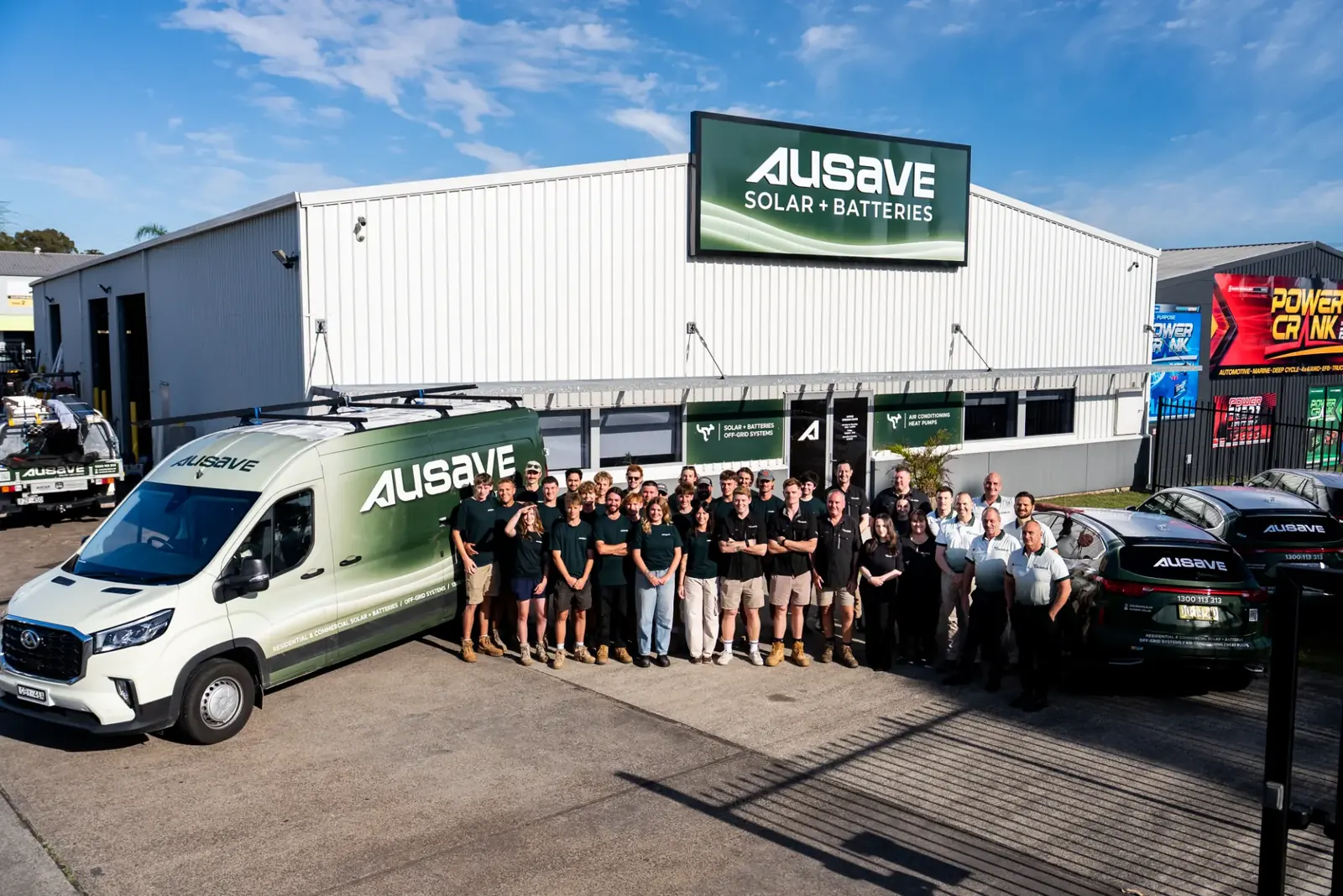
Meet The Family Behind Ausave
Mark, Mitch and their dad Lloyd explain who we are, where we install and what happens after you ask for a quote.
What happens after you ask for a quote
- Our office team calls to book a time that suits you.
- A specialist goes through your bills, meter box and roof with you.
- We design the right system around how your home uses power.
Start with how you use your car
A home EV charger lets you plug in where you normally park, rather than organising every top-up around a public charging stop. The useful starting point is your routine: when the car is home, how much charge you usually need and when it must be ready to leave.
A dedicated AC wall charger may suit overnight charging or daytime charging while solar is producing. Solar panels are not required to install one. We discuss your driving needs and electricity plan before recommending a configuration, rather than assuming the highest charger rating is the right choice.
Match the charger to your EV model
Tell us the make, model, model year and Australian specification of your EV or plug-in hybrid. Type 2 is a standard AC connector used in Australia; CCS2 and CHAdeMO are DC connector types. An imported or older vehicle may need different consideration, so we check its charging requirements rather than treating every EV as interchangeable.
The vehicle’s charging limit matters as well as the charger rating. A higher-rated unit does not make every car charge at that rate. We confirm the proposed Sigenergy equipment, connector and supported functions against your vehicle documentation, including any future second vehicle you are planning for.
Choose a practical parking and cable route
The charger position should work with the car’s charging-port location and the way you park. We consider cable reach, access around the vehicle, cable storage and a route that avoids creating a trip hazard. A garage wall, carport or outdoor mounting position each needs a property-specific assessment.
The cable route from the switchboard can affect the installation scope. Tell us about detached garages, shared driveways or areas where cabling would need to cross common property. For a rental or strata property, obtain the necessary owner and strata permissions before work proceeds. A wallbox is not a substitute for an approved charging arrangement in a shared parking area.
Check the switchboard and available supply
EV charging adds a sustained electrical load. Our licensed crew assesses the switchboard, existing wiring, circuit protection, earthing and available supply alongside other household loads. Whether your property has single-phase or three-phase power influences the suitable configuration; three-phase charging is not available simply because a charger supports it.
We explain any identified switchboard, circuit or supply work in the quote. Ausgrid advises that a connection application may be needed where the supply requires upgrading. We check the relevant network requirements for your address, including properties outside Ausgrid’s area. Load management can help control charging demand, but it does not replace suitable wiring or required network approval.
Coordinate charging with solar and storage
Sigenergy AC charging offers solar-surplus, scheduled and battery-boost modes in supported configurations. Solar-surplus charging uses available generation after other demands, so the result depends on the weather, household consumption and whether your car is plugged in. Scheduling can also align charging with your electricity tariff; the right settings depend on your plan.
With compatible home battery integration, charging priorities and a battery state-of-charge cut-off help manage how stored energy is used. Dynamic load management requires the Sigen Power Sensor and correct configuration. It adjusts charging power as household demand changes. We discuss these functions as part of the whole system, not as a promise of free charging or unlimited energy.
AC, optional DC and bidirectional charging
AC wall charging is the starting point for many home installations. A Sigenergy DC charging module is a separate possibility within a suitable system design, subject to equipment availability, vehicle compatibility and electrical assessment. DC capability should not be assumed from an AC charger quote.
Vehicle-to-home, or V2H, supplies energy from a compatible vehicle to the home; vehicle-to-grid, or V2G, exports it to the electricity network. Neither is a universal EV feature. Both depend on vehicle software, manufacturer support, compatible equipment and applicable standards and network requirements. Backup during a power outage needs its own supported design.
For V2G on Ausgrid’s network, the equipment must meet its AS/NZS 4777.2 and equipment approval requirements, and each premises needs a connection application. Sigenergy’s published field tests are not vehicle-manufacturer certification. We confirm the proposed arrangement before describing bidirectional functions as available.
A Newcastle quote with a defined scope
Established in 2010, Ausave Energy operates from our Cardiff depot in Lake Macquarie. Our in-house SAA-accredited, licensed electrical crews carry out the installation without subcontractors. We are a Sigenergy Gold Installer NSW and exclusively install Sigenergy batteries, inverters and EV chargers.
For an EV charger quote, share your suburb, vehicle details, switchboard photos and intended parking position. We confirm what further assessment is needed and explain the proposed equipment and electrical work. Our Lifetime workmanship warranty covers installation workmanship; manufacturer product warranties are separate.
Your questions answered
Do I need solar panels for a home EV charger?
No. A suitable charger can use grid electricity. Solar integration is an option if compatible equipment and your charging routine make it useful.
Will every EV work with the same Sigenergy charger?
No universal compatibility is promised. We check the exact model, connector, vehicle charging limits and supported functions before recommending equipment.
Will my switchboard need upgrading?
That depends on the inspection, existing circuits and available supply. The quote explains any identified work; load management does not automatically remove upgrade requirements.
Can I install a charger in an apartment car space?
Possibly, subject to strata and owner permissions, building supply capacity, cable routing and an agreed charging arrangement. Shared parking requires assessment before equipment is selected.
Can my EV power the house during a blackout?
Only with a specifically supported vehicle, charger and backup system design. Owning an EV or a Sigenergy AC charger alone does not establish V2H or blackout capability.
Explore your options
Planning guides and references
Your home. Your energy needs.
Get my free quote
Tell us what you have now and what you would like to install. Our team will check the property, explain suitable options and provide a written quote. No obligation.
Call 1300 113 313 if you would prefer to speak with Ausave.
What are you looking for?
Choose one to start. The form takes about 2 minutes.