
Solar + Batteries
Solar & Battery Installation in the Hunter Valley
Plan solar and battery storage for your Hunter Valley home with Ausave Energy. Established in 2010, we work from our Cardiff depot in Lake Macquarie with in-house SAA-accredited licensed electrical crews and no subcontractors. We are a Sigenergy Gold Installer NSW, exclusively installing Sigenergy batteries, inverters and EV chargers, with a Lifetime workmanship warranty.Hunter Valley solar and batteries, planned around your home, sheds, supply and cable routes.
What are you looking for?
Choose one to start. The form takes about 2 minutes.
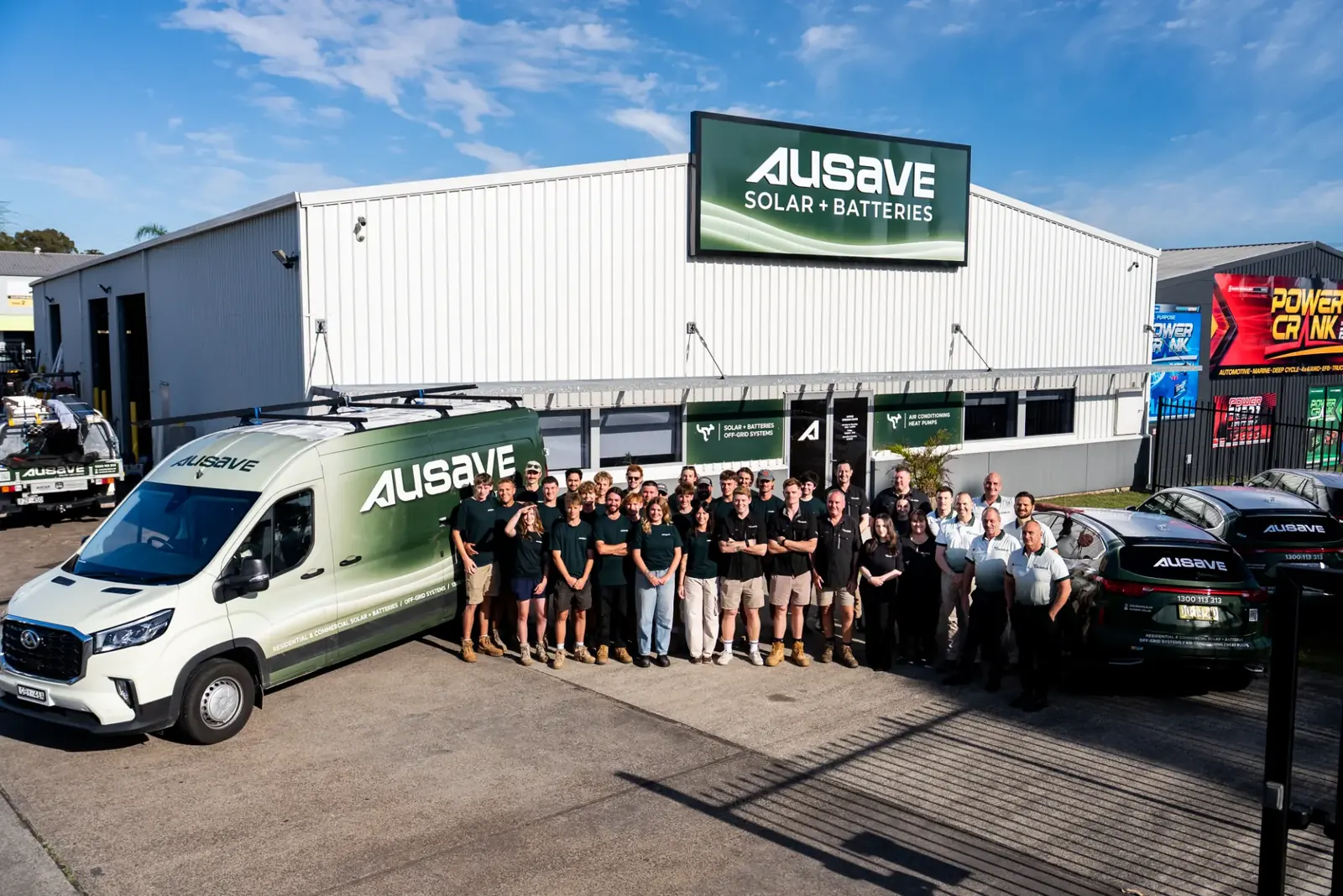
Meet Ausave
Meet The Family Behind Ausave
Mark, Mitch and their dad Lloyd explain who we are, where we install and what happens after you ask for a quote.
What happens after you ask for a quote
- Our office team calls to book a time that suits you.
- A specialist goes through your bills, meter box and roof with you.
- We design the right system around how your home uses power.
What customers say
Google reviews of Ausave Energy
4.7 out of 5 from 277 Google reviews
“From the start, booking an assessment with their sales team to evaluate our home's needs was seamless.”
“Professional and clean install. Competitively priced. Great communication through the whole process from quote to post install questions.”
“The quality of the installation was exceptional, with great attention to detail and a really high standard of workmanship. Everyone was professional, friendly and easy to deal with throughout the entire process.”
These are general reviews of Ausave’s service, not verified Hunter Valley project references. Google does not provide reviewer suburbs. Suburb labels are awaiting confirmation; no customer surname is displayed.
A plan for the house and the rest of the property
For homeowners in Cessnock, Kurri Kurri, Singleton, Branxton and Muswellbrook, the starting point is the same: understand where electricity is used before choosing where to generate it. A house with a nearby garage needs a different assessment from a rural home with a separate workshop, water pump or machinery shed. We consider those buildings together rather than treating the house roof as the only option.
Tell us which buildings share your electricity meter and which have separate supplies. A shed on the same block is not necessarily connected to the house switchboard. Existing solar, controlled hot water and planned equipment also belong in the conversation. This helps establish whether the project is a straightforward home installation or needs a more detailed electrical design before a useful quote can be prepared.
A large shed roof is an option, not an assumption
If your Hunter Valley property has a shed, its roof may offer another place for solar panels. We still need to assess its condition, structure, roof material, orientation and shading. Available roof area alone does not establish that the building can support an array or that placing panels there is practical. Trees, nearby buildings and the route back to the electrical supply all affect the decision.
For an existing house-and-shed layout, compare the whole installation rather than just the number of panels each roof can hold. A smaller array closer to the main switchboard may avoid work needed for a remote shed; another property may suit the shed better. We explain the proposed roof, mounting approach and electrical route in the quote so you can understand why that arrangement was selected.
Long cable runs need to be designed early
On an acreage property, the distance between a shed, inverter, house switchboard and supply connection can change the design. Long cable runs need assessment for voltage drop when supplying loads and voltage rise when exporting solar. The NSW Service and Installation Rules address both. An existing cable that powers shed lights is not automatically suitable for carrying the proposed solar generation back towards the meter.
We assess the route, cable size, connection points and protection rather than assuming the current shed feed can be reused. Where a new underground route is proposed, tell us about water lines, drainage, access tracks and other known services. Any trenching or electrical upgrade should be clear in the scope. Resolving this before equipment selection avoids a quote that overlooks the connection between a promising roof and the home it is meant to serve.
Match the system to single-phase or three-phase supply
A Hunter Valley address does not tell us whether the property has single-phase or three-phase electricity. We check the actual supply and switchboard, then consider loads such as workshop equipment, pumps, air conditioning and a future EV charger. If equipment needs three-phase power, that requirement must be included in the design; a battery is not a substitute for the correct electrical supply.
Battery storage capacity is measured in kWh. Inverter power is measured in kW and determines how much power can be delivered at a time. These are different considerations. Backup also needs a phase-by-phase assessment: a system serving selected circuits or one phase must not be described as automatically covering every building and every three-phase load. We identify any proposed supply changes separately rather than assuming an upgrade is necessary.
Check the distributor for your particular connection
For a property in or beyond Muswellbrook, or elsewhere in the outer Hunter, we confirm the electricity distributor before applying its connection rules. Do not assume that every address described as Hunter Valley is on Ausgrid. Your bill usually identifies the distributor; if it is unclear, your electricity retailer can help. The distributor is the network operator, not necessarily the company sending your bill.
For an Ausgrid connection, its solar and battery application process and inverter requirements apply. If the property is on Essential Energy, its connection conditions apply instead. The approved export arrangement depends on the application and relevant network requirements, not just available roof space. Adding a battery or enlarging existing solar can also require a connection review. We check the approval pathway for the actual proposed system rather than promising an export allowance from a postcode.
Choose storage around household use and essential loads
For a home with daytime pumping or workshop activity, look at how much solar is used while it is being generated before deciding how much to store. Evening cooking, heating, cooling and other household demand may create a different storage requirement. We review available bills or interval data alongside the proposed solar array. A large rural roof does not, by itself, justify a large battery.
If backup matters, list the circuits you want available during an outage. Refrigeration, lighting and a water pump may be priorities, but a pump needs assessment for its operating and starting demand. Backup requires compatible equipment, correct configuration and an agreed circuit scope. Runtime depends on stored energy and the loads in use. A grid-connected home battery should not be presented as unlimited power for the house, workshop and every outbuilding through an extended outage.
Battery location and access belong in the site assessment
A rural shed can contain fuels, chemicals or moving vehicles, so an empty wall is not automatically an appropriate battery location. The NSW Government recommends considering nearby fuel and chemicals, bushfire and flooding risks. We assess locations against installation requirements and manufacturer instructions, including access, clearances and protection where needed. These constraints matter when comparing house and shed locations.
To prepare for a Hunter Valley assessment, share your suburb, electricity bill, existing system details and safe photos of the roofs, meter and switchboard without opening electrical covers. Explain gates, access restrictions and the buildings involved so we can plan the visit from Cardiff. The quote should identify equipment, cable work, backup scope and any eligible government incentives separately, with manufacturer product warranty terms distinguished from our Lifetime workmanship warranty.
Local installation gallery
REAL INSTALL PHOTO: Hunter Valley
Awaiting a genuine Ausave Energy installation photo from Cessnock, Kurri Kurri, Singleton, Branxton or Muswellbrook, identified by suburb only. No street address, customer identity or unconsented faces. This placeholder is not installation evidence.
Planned image description: Desired genuine Hunter Valley installation photo showing solar panels on the assessed house or shed roof, with the suburb confirmed before use.
Photo slot awaiting a genuine Ausave installation image and confirmed suburb. No stock image is used as installation evidence.
Your questions answered
Can solar panels go on my rural shed rather than the house?
Potentially. We assess the shed roof, shading, structure and electrical connection back to the property supply. A suitable roof is only one part of the decision; the cable route and any required upgrades must also be included.
Is every Hunter Valley property connected to Ausgrid?
We do not assume that. Confirm the distributor for your actual connection using your electricity bill or by asking your retailer. This is particularly important for outer-region enquiries, including properties in and around Muswellbrook. The applicable network rules depend on that connection.
Do I need three-phase power to install a home battery?
Not automatically. The design depends on your existing supply, equipment and intended backup loads. Three-phase workshop machinery and pumps require specific assessment, and a backup arrangement must clearly state which phases and circuits it can support.
Will the battery run my water pump during a blackout?
Only if the pump is included in a compatible, correctly configured backup design. Its phase, starting demand and running power need checking. How long it can run depends on available battery energy and other loads operating at the same time.
Who installs the system, and what does the workmanship warranty cover?
Ausave Energy uses in-house SAA-accredited licensed electrical crews, with no subcontractors. Our Lifetime workmanship warranty relates to installation workmanship. Sigenergy product warranties have their own terms and are not a lifetime battery or inverter warranty.
Explore your options
Planning guides and references
- NSW Service and Installation Rules, June 2025
- NSW Government guide to owning a battery
- Australian Government battery and backup guidance
- Ausgrid network-area check
- Energy Made Easy: identifying your distributor
- Ausgrid solar and battery connection process
- Ausgrid NS194 inverter connection requirements
- Essential Energy solar connection conditions
Your home. Your energy needs.
Get my free quote
Tell us what you have now and what you would like to install. Our team will check the property, explain suitable options and provide a written quote. No obligation.
Call 1300 113 313 if you would prefer to speak with Ausave.
What are you looking for?
Choose one to start. The form takes about 2 minutes.